

Wireless Equestrian Air Vests: Are Tether-Free Airbags the Future of Rider Safety?
Kristina LewisCould the Future of Equestrian Air Vests Be Tether-Free?
Tiny computers. Split-second decisions. A galloping thousand-pound animal. And somewhere in the middle of all that chaos, a vest trying to predict disaster before it happens.
Wireless equestrian air vests may sound futuristic, but wearable rider safety technology is already evolving rapidly.
For years, equestrian air vests have worked on a beautifully simple concept: if the rider separates from the horse, a tether connected to the saddle activates a CO₂ cartridge and inflates the vest.
Mechanical.
Reliable.
Proven.

But outside the horse world, rider safety technology has already evolved far beyond physical tether systems.
Modern motorcycle airbags now use sensors, gyroscopes, accelerometers, predictive crash algorithms, and AI-assisted motion detection to deploy automatically without any physical tether at all.
Some systems even connect directly to smartphone apps, allowing riders to monitor battery life, diagnostics, software status, and system readiness in real time.
And that raises a fascinating question for equestrian sports:
Is wireless airbag technology the next evolution of rider safety?
For riders exploring current protection options, Farm House Tack carries equestrian air vests and rider safety gear designed to support safer rides today while technology continues to evolve.
Motorcycle Airbags Quietly Became Smart Technology

Much of today’s wireless airbag technology evolved from the motorcycle world.
Companies like Dainese and Alpinestars spent years developing wearable airbags for MotoGP riders, where crashes happen at terrifying speeds and milliseconds matter.

Systems like the Alpinestars Tech-Air 5 now use accelerometers, gyroscopes, crash algorithms, and predictive motion analysis to determine when a rider is genuinely crashing versus simply moving aggressively.
Instead of waiting for physical separation from the motorcycle, the system attempts to recognize the crash itself before impact happens.
Unlike traditional safety equipment, many motorcycle systems now interact directly with riders through smartphone apps.
To better understand how riders adapt to automatic airbag technology, I spoke with my husband, Billy Gould, a motorcycle rider who has owned both Dainese and Alpinestars airbag systems. While he is not an equestrian, his experience offers an interesting perspective from another high-risk sport that has already embraced wireless airbag protection.
One of the first things Billy mentioned was the app.
“I was sold on that. I’m able to see the battery level and have peace of mind.”
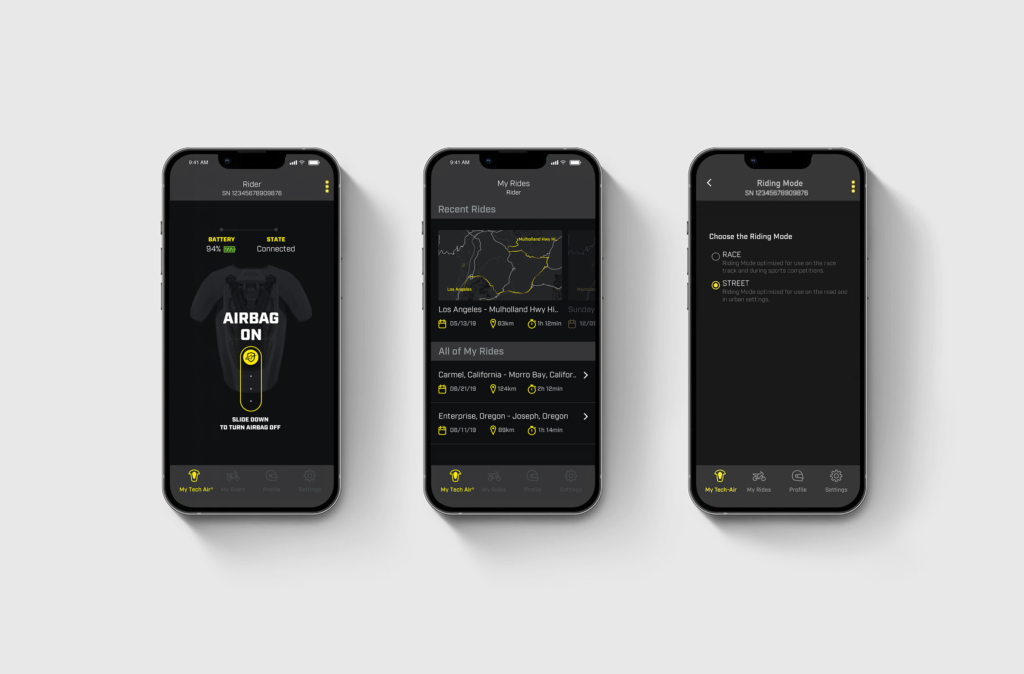
That sentence says a lot.
Motorcycle airbags are no longer just protective equipment.
They are becoming intelligent wearable technology.
What Is a Wireless Equestrian Air Vest?
Unlike traditional equestrian air vests that require a physical tether attached to the saddle, wireless systems use internal electronics to detect a fall automatically.
Inside the vest are accelerometers, gyroscopes, motion sensors, and advanced crash-detection algorithms.
The vest constantly analyzes rider movement in real time, searching for patterns that indicate a crash is occurring. Instead of waiting for the rider to physically separate from the horse, the system attempts to recognize the fall itself and deploy instantly.
In theory, that means earlier protection, earlier stabilization, and earlier impact reduction.
And in a sport where milliseconds matter, that is a very big deal.
How Does a Wireless Airbag Know You’re Falling?

One of the most important components is the gyroscope.
While accelerometers measure changes in speed and direction, gyroscopes measure rotation, tilt, and body position. Think of a gyroscope as the vest’s sense of balance. It helps the system understand how a rider’s body is moving through space.
If a rider is suddenly pitched forward, rotated sideways, or experiencing rapid changes in orientation during a fall, the gyroscope records those movements. Combined with accelerometer data, the system creates a real-time motion profile that helps distinguish normal riding movement from a genuine accident.
In simple terms, the vest is not just looking for movement. It is looking for a pattern of movement that resembles a fall.
Every movement creates a unique signature.
Walking creates one pattern.
Posting creates another.
Jumping creates another.
A rotational fall creates something entirely different.
The challenge is teaching the system to recognize those differences accurately and quickly enough to matter.
Why Wireless Airbag Technology Is So Difficult in Horse Sports
This is where things become incredibly complicated.
Horseback riding is not predictable.
A rider landing off a large oxer can create impact forces that resemble a collision.
A horse stumbling may throw the rider violently forward without causing a fall.
A spinning horse, awkward distance, sliding stop, rear, or buck can all produce chaotic movement patterns that electronic systems must interpret correctly.
Unlike motorcycles, horses think.
They have fear.
They react.
They make decisions independently from the rider.
Billy believes the technology itself may already be capable of evolving into equestrian sports.
“The gyroscopic data that the sensors collect can be mapped to changes in terrain, and we know this because similar systems already exist for adventure motorcycles.”
He believes the challenge is not whether the technology can work around horses.
“I don’t see why the equestrian tech could not be taught about horses, because this all operates through AI.”
And honestly, that may become one of the biggest future conversations in equestrian safety.
Because suddenly, the question stops being:
“Is this possible?”
And starts becoming:
“How close are we really?”
Different Disciplines Create Different Challenges
One of the biggest technological hurdles for wireless equestrian air vests is that every discipline moves differently.
A dressage rider sits differently than an eventer.
A hunter rider moves differently than a barrel racer.
A reiner creates completely different movement patterns than a jumper galloping to a combination.
The algorithm has to distinguish between normal aggressive riding, discipline-specific movement, and a catastrophic fall in progress.
That distinction is extraordinarily difficult.
Especially considering that horse riders are constantly shifting balance, changing position, adjusting contact, standing in stirrups, landing from fences, and absorbing movement through their bodies.
Horseback riding creates an incredibly dynamic motion environment for any electronic system to interpret correctly.
Wireless Airbag Systems Are Already Emerging
While tether systems still dominate the equestrian world, wireless systems are already beginning to emerge.
Several companies are now experimenting with electronic deployment systems, sensor-based activation, and AI-assisted crash detection.
These systems attempt to recognize falls automatically using motion sensors, gyroscopes, accelerometers, and predictive crash analysis rather than relying on a physical tether connected to the saddle.
The technology is no longer theoretical.
The bigger question now may be:
How quickly will riders trust and adopt it?
Why Earlier Deployment Matters
One of the most promising aspects of wireless airbag technology is the possibility of earlier crash recognition.
Traditional tethered systems generally inflate after rider separation begins. Wireless systems, however, are designed to recognize a fall before full separation occurs.
That distinction may be particularly important in some of the most serious accidents in equestrian sports.
One example is the rotational fall, which remains among the most dangerous incidents in disciplines such as eventing and cross-country riding. In these situations, a horse may impact a fence or obstacle, causing the momentum of both horse and rider to carry forward. The rider can be projected, trapped, or crushed before complete separation from the horse even occurs.
Traditional tethered air vests activate only after enough physical separation occurs to trigger the tether. Wireless systems, by contrast, attempt to recognize the crash sequence itself.
At first glance, both technologies are incredibly fast. Many tethered equestrian air vests fully inflate in roughly 80 to 100 milliseconds once activated. Electronic systems are also designed to deploy in milliseconds, with some manufacturers advertising inflation times of less than 60 milliseconds.
However, the most important difference is not necessarily how fast the vest inflates. It is when the vest begins the deployment process.
A tethered system must wait until the rider has separated far enough from the saddle to pull the tether. An electronic system is constantly monitoring rider movement through accelerometers, gyroscopes, motion sensors, and predictive algorithms, allowing it to search for signs of a fall before that separation occurs.
In theory, an electronic system could potentially begin inflation during the earliest stages of a rotational fall — milliseconds before impact, before full rider ejection, or during the initial forward motion of the accident itself.
That earlier deployment window may ultimately become one of the most important areas of future equestrian safety research.
Researchers, riders, and manufacturers are increasingly focused on a central question:
Could earlier crash recognition provide earlier stabilization during some of the most dangerous falls in horse sports?
That possibility is one reason the industry continues investing heavily in sensor-based rider protection technology.
At the same time, rotational falls also highlight the immense challenge facing wireless systems. The technology must distinguish between aggressive riding, awkward movement, jumping effort, sudden balance corrections, and a true catastrophic fall sequence, all within fractions of a second.
And in horseback riding, those lines can blur very quickly.
In other words, the future of airbag technology may not be determined by which vest inflates the fastest. It may be determined by which system can recognize a true emergency the earliest and most accurately.
What Does Current Research Say About Air Vests?
Research on equestrian air vests is still developing, and the results are not always simple.
Laboratory testing has shown that airbag vests can reduce certain impact forces, especially around the torso and spine. However, real-world riding accidents are much harder to study because every fall is different.
A 2016 study evaluated the protective potential of airbag vests for equestrian sports, while later eventing research examined whether riders wearing air jackets had reduced injury risk during falls. More recent safety reviews emphasize that air vests may be useful as part of a broader rider safety system, but they should not be treated as a guarantee against injury.
That distinction matters.
Air vests are not magic.
They are one part of a larger safety picture that may include a properly fitted helmet, correct tack, rider education, discipline-specific safety rules, and, when required, a certified body protector.
The Biggest Challenge: False Deployments
One of the hardest balancing acts in wireless airbag technology is avoiding false activations while still deploying quickly enough during a real fall.
Potential false-trigger situations include hard jump landings, abrupt stops, sliding dismounts, horse bucks, spins, and unexpected rider movement on the ground.
A vest that inflates unnecessarily can startle horse and rider, require cartridge replacement, interrupt performance, and damage rider confidence in the technology.
The goal is precision:
Deploy only when absolutely necessary, but deploy fast enough to matter.
That is where modern crash-detection AI is doing its most important work.
What Injuries Are These Vests Trying to Prevent?
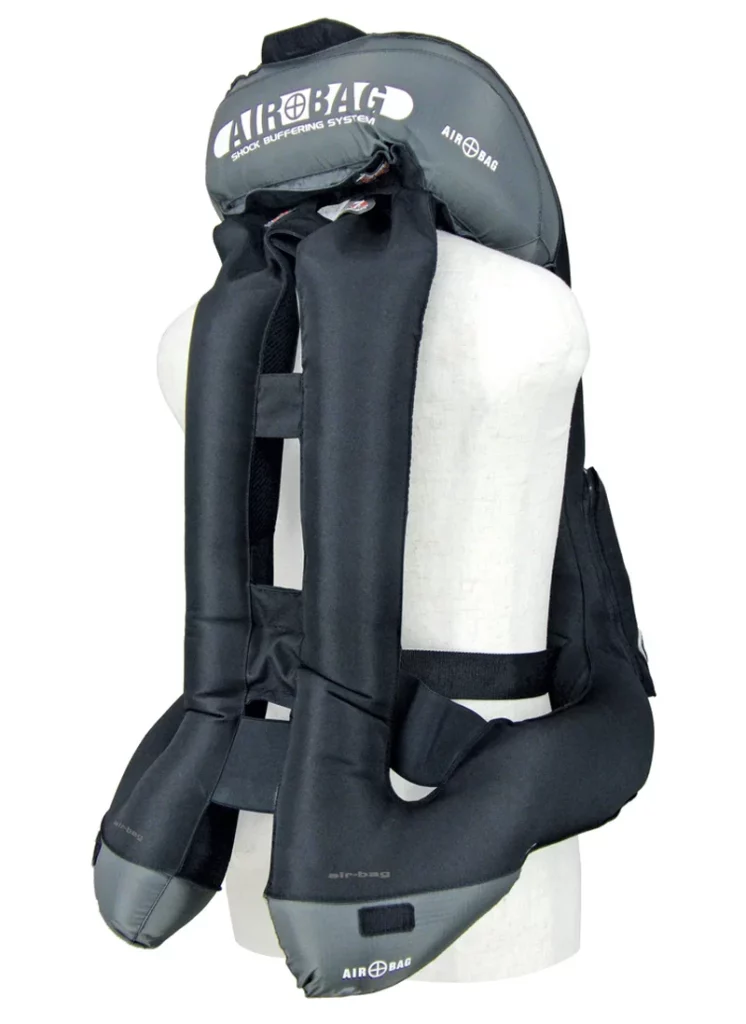
Whether tethered or electronic, the primary goal of an equestrian air vest is the same: to help reduce the severity of injuries during a fall.
When deployed, the airbag creates a cushion of protection around key areas of the rider’s upper body, including the ribs, chest, spine, collarbone, back, and internal organs.
Many air vests also provide additional stabilization around the neck and upper torso, helping limit excessive movement during an impact.
It is important to remember that no air vest can prevent every injury, and air vests should not be viewed as a replacement for proper riding safety equipment or a certified body protector when required by your discipline.
However, the goal is simple: reduce the force transferred to the rider’s body during a fall and potentially lessen the severity of certain injuries.
This is also one reason electronic airbag technology has generated so much interest. Some researchers and manufacturers believe that recognizing a fall earlier could allow protection to begin sooner, particularly in fast-moving accident scenarios where milliseconds matter.
The Psychology of Trust
One of the most fascinating parts of modern airbag technology is not the engineering.
It is the psychology.
Billy admitted that trusting the technology did not happen overnight.
“There was always a reminder in the back of my mind that there could be a false deployment.”
That fear feels incredibly familiar to equestrians currently discussing wireless air vest technology.
What if it inflates unexpectedly?
What if it mistakes movement for a crash?
What if it activates during a jump effort or awkward landing?
But over time, trust in the technology evolved.
One experience actually increased Billy’s confidence in the technology.
“I dropped my bike at the airport one day because a lady almost hit me in an intersection. I bailed, fell on my side, and rolled up to my feet without a deployment. That actually is what made me trust it more, honestly.”
Because the system correctly interpreted the situation.
Not every fall required deployment.
That level of algorithm refinement may eventually become critical in equestrian sports as well.
Traditional Tether Systems Still Have Real Advantages
And this part matters.
Tethered equestrian air vests are still trusted for very good reasons. They are mechanically simple, proven, easy to understand, and widely used in real riding environments.
There is comfort in physical activation. Riders understand how the system works, when it activates, and what triggers deployment.

That simplicity creates confidence.
And in a sport built heavily around feel, instinct, and trust, that matters more than many people realize.
Tethered vs. Wireless Air Vests: Practical Pros and Cons
Before breaking down the advantages and drawbacks, here is a quick side-by-side look at how tethered and wireless air vest systems compare.

As exciting as electronic airbag technology may be, traditional tethered systems still offer several practical advantages that many riders appreciate.
Tethered Air Vests
Advantages
No batteries to charge
No software updates
Easy cartridge replacement
Often ready to ride again quickly after deployment
Familiar activation method many riders already trust
Potential Drawbacks
Requires clipping into the saddle
Cannot activate until rider separation begins
Riders occasionally forget to connect the tether
Less opportunity for predictive deployment
Wireless Air Vests
Advantages
No tether required
Potentially earlier crash recognition
Smartphone app connectivity
Battery and system monitoring
Software updates and future improvements
Greater potential for AI-assisted development
Potential Drawbacks
Requires charging
More technology to manage
Higher purchase cost
Greater reliance on sensors and software
Some systems may require manufacturer servicing after deployment
The difference is not necessarily old versus new.
It is simplicity versus intelligence.
One relies on mechanical certainty.
The other relies on predictive technology.
Living With the Technology
When comparing tethered and wireless air vests, daily ownership matters just as much as deployment speed.
Tethered systems are often praised for their simplicity. After deployment, many riders can replace the CO₂ cartridge themselves and return the vest to service quickly if it has not been damaged. Maintenance typically involves inspecting the cartridge, checking for wear, and following manufacturer cleaning and storage recommendations.

Electronic systems add another layer of ownership. Riders must monitor battery levels, charge the system regularly, and occasionally update software through a companion app. Depending on the manufacturer, some deployments may require inspection, servicing, or replacement components before the vest can be returned to service.
Neither system is inherently better.
They simply ask different things from the rider.
Frequently Asked Questions About Equestrian Air Vests
Are wireless equestrian air vests available now?
Wireless airbag technology is beginning to appear in equestrian safety equipment, but traditional tethered systems are still the most familiar and widely used option for many riders. As the technology continues to develop, riders will likely see more sensor-based systems designed specifically for horse sports.
How is a wireless air vest different from a tethered air vest?
A tethered air vest uses a lanyard attached to the saddle. When the rider separates from the horse, the tether activates the airbag. A wireless air vest uses sensors, accelerometers, gyroscopes, and crash-detection software to recognize a fall without a physical tether.
Are tethered air vests still a good choice?
Yes. Tethered air vests remain popular because they are simple, proven, and easy to understand. Many riders like that they do not require charging, software updates, or app monitoring.
Can an air vest replace a certified body protector?
No. An air vest should not be viewed as a replacement for a certified body protector when one is required by your discipline or competition rules. Many riders use both, depending on the activity and safety requirements.
What should riders consider before buying an air vest?
Riders should consider fit, discipline, comfort, compatibility with other safety gear, cartridge replacement, maintenance, charging requirements if electronic, and whether the system meets the rules for their sport or organization.
Do air vests prevent all injuries?
No safety product can prevent every injury. Air vests are designed to help reduce impact forces and provide additional protection during certain falls, but they should be part of a broader safety approach that includes proper instruction, helmets, appropriate tack, and discipline-specific protective equipment.
Do air vests require special maintenance?
Yes. Riders should always follow the manufacturer’s instructions for cleaning, storage, cartridge replacement, inspection, and service. Tethered systems may require CO₂ cartridge replacement after deployment, while electronic systems may also require charging, app checks, software updates, or manufacturer inspection.
So… Is Wireless Airbag Technology the Future of Equestrian Safety?
Possibly.
The technology is advancing quickly.
The investment is growing.
And the potential safety benefits are difficult to ignore.
At the same time, equestrian sports remain uniquely difficult for AI to interpret.
A horse is not a motorcycle.
A jump landing is not a car accident.
And riders need complete trust in their equipment before widespread adoption truly happens.
Right now, the equestrian world feels suspended between two eras: the dependable simplicity of mechanical tether systems and the sleek promise of predictive wearable technology.
The next decade may determine whether wireless airbag systems become the new standard in rider safety or remain a high-tech niche alongside trusted traditional designs.
Either way, one thing is becoming increasingly clear:
The future of rider protection is no longer just inflatable. It is intelligent.
Need Help Choosing Rider Safety Gear?
Curious about air vests, helmets, or rider safety gear? The Farm House Tack team is always happy to help riders compare options, understand fit, and choose safety equipment that fits your discipline, comfort level, and goals.
Come by and see us in-store for personalized help, or, if you can’t make it in, we also offer virtual fittings to help riders shop with more confidence from home.
Visit us in-store, schedule a virtual fitting, or shop rider safety gear online.